


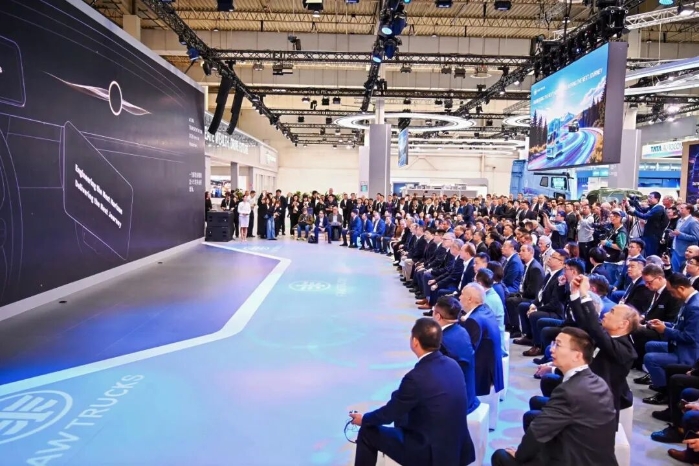
This photo shows the launch event of FAW TRUCKS at IAA Transportation in Hannover, Germany. (Photo provided by FAW TRUCKS)
FAW TRUCKS, a Chinese commercial vehicle manufacturer, recently showcased a range of vehicles, core assemblies, and smart connectivity solutions at IAA Transportation in Hannover, Germany, as it seeks to expand its presence in the European market.
At the world's premier commercial vehicle exhibition, the company also proposed a forward-looking shift from the traditional model of "selling a single vehicle" to delivering "smart transport capacity," reflecting the veteran maker’s remarkable transformation as it embraces green and smart industry trends.
"We hope this exhibition will become an important milestone in our entry into the European market," said Li Sheng, chairman of FAW TRUCKS. "Building on our seven-decade history, we aim to develop multi-energy solutions suited to European market needs."
FAW TRUCKS outlined its vision for the future of the commercial vehicle industry with three primary pillars: green transition, intelligent technologies, and ecosystem building.
Amid a changing energy landscape, the company is pursuing a multi-energy strategy and developing flexible vehicle architectures compatible with diesel, natural gas, hydrogen, battery-electric, and hybrid powertrains.
FAW TRUCKS is also exploring the application of artificial intelligence in vehicle development. Li said that in the future, commercial vehicles will further evolve from traditional transport equipment into intelligent transport capacity terminals capable of autonomous perception, decision-making, and optimization.
"The future commercial vehicle will need to know what cargo it is carrying and where it is headed, as well as its own conditions, such as whether it has enough energy and whether there are any faults," Li noted.
The company is also expanding its business model beyond the delivery of vehicles, aiming to provide financing, maintenance, leasing, and remanufacturing services throughout the vehicle’s life cycle, from purchase to replacement.
According to Li, what manufacturers offer customers may no longer be just the vehicle itself in the future. What they sell is transport capacity, providing related services throughout the vehicle’s life cycle. This is precisely the "smart transport capacity solution" put forward by FAW TRUCKS.
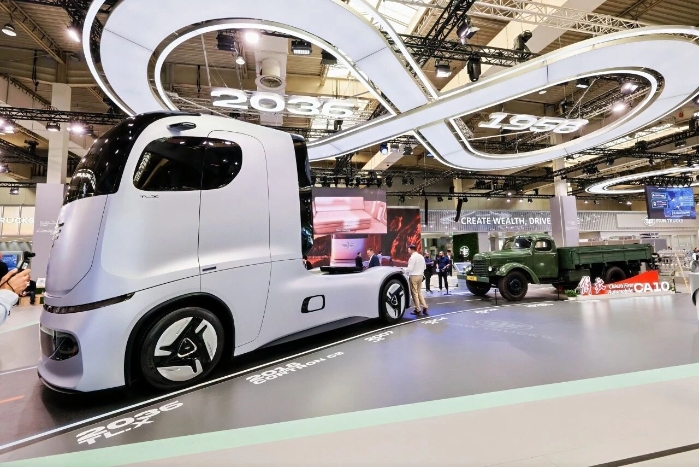
This photo shows the booth of FAW TRUCKS at IAA Transportation in Hannover, Germany. (Photo provided by FAW TRUCKS)
| Editor: Duying
| Initial Review: Chen Duohua
| Second Review: Liu Shumei
| Final Review: Li Xiang

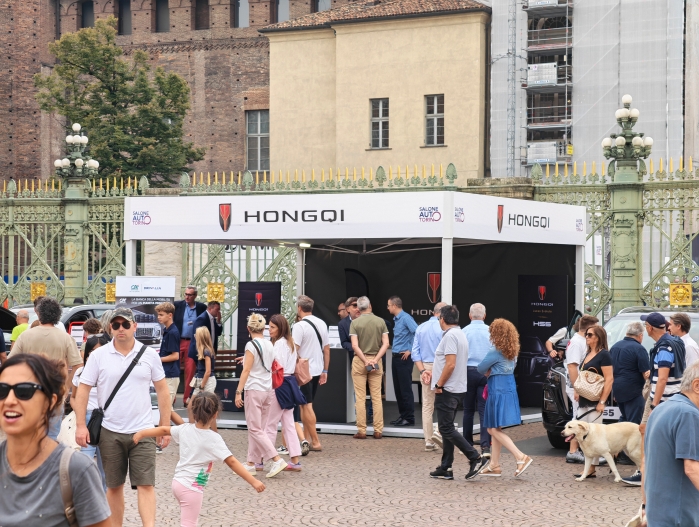
From September 11 to 13 local time, the 2026 Turin Auto Show (Salone Auto Torino) opened with great fanfare in downtown Turin, Italy.
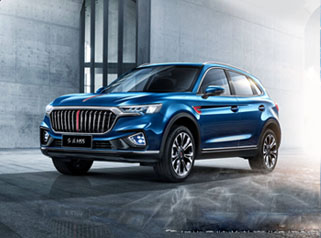
Together with its Italian distribution partner EMC Auto (Eurasia Motor Company), Hongqi officially announced its entry into the Italian market with the launch of two premium SUV models, the HS3 and HS5, marking another milestone in Hongqi’s global journey within a core European market.

Through partnerships with local players — including Italy's leading media outlet La Stampa, financial mobility services provider AUTOBANK, and its mobility platform DRIVALIA — Hongqi is building a "product + communication + marketing services" system and rapidly advancing its establishment in the Italian market.
Turin Auto Show: A Key Stage for the European Automotive Industry
The Turin Auto Show is one of the major annual events in the Italian automotive world and an important window for European automakers to engage directly with consumers.

Bringing together more than 40 automotive brands and design institutions, it presents 132 new products, including dozens of models making their Italian market debut. Its exhibition areas span Piazza Castello, Piazzetta Reale, the gardens of the Royal Museums of Turin, and the area around the Teatro Regio (Royal Theatre) of Turin. Open to the public free of charge, the show has drawn a cumulative attendance of more than 500,000 visitors over its previous two editions.
By choosing this bellwether show to announce its debut in Italy, Hongqi not only demonstrates its high regard for the Turin Auto Show’s industry standing, but also takes a key step in further deepening its European presence and transitioning from a trade-oriented model to a marketing-oriented model.
Hongqi Officially Enters Italy: HS3 and HS5 Twin-Star Lineup Opens a New Luxury Chapter
During the show, Hongqi and EMC Auto officially announced the brand’s launch in the Italian market, alongside the presentation of its two premium SUVs — the HS3 and HS5. This marks a further expansion of Hongqi’s European footprint, extending its reach from Norway, where it first entered in 2021, to Italy, a core automotive market in Southwestern Europe.

As the vanguard lineup for Hongqi's entry into Italy, the HS3 and HS5 both offer a rich array of technology and comfort features, reflecting Hongqi's premium positioning for the European market.
Deepening the Local Ecosystem: Hongqi Collaborates with Italian Partners Across Multiple Fronts
Beyond the product launch, Hongqi’s Italian market debut features two key partnerships, further bolstering the brand’s communications and service infrastructure in Italy.
Partnering with Top Italian Media Including La Stampa to Highlight HS3 , the Brand's Core Sales Model
Hongqi has entered into a content partnership with Italy's leading daily La Stampa and other media outlets, which will feature reporting and test-drive experience coverage centered on its core sales model, the HS3. Through formats such as in-depth product analysis, on-site coverage of the Turin Auto Show, and user-perspective reviews, the partnership will help Italian consumers gain a close-up understanding of the brand and the product strength of the HS3, while accelerating brand awareness.
Joining Forces with AUTOBANK and DRIVALIA to Build a Diversified “Buy, Lease, Subscribe, Share” Vehicle-Use Service Matrix
To broaden the car-buying and car-use options available to Italian customers, Hongqi has announced a partnership with Italian financial mobility services provider AUTOBANK and its mobility platform DRIVALIA. Leveraging DRIVALIA’s well-established mobility service network in Italy, the two parties will create a one-stop vehicle-use service system for Hongqi models, covering vehicle purchase financing, leasing, subscription, and sharing.

Test-Drive Experience a Hit: Hands-On HS3 Drives Draw Widespread Praise
During the show, the Hongqi HS3 featured on the official Turin Auto Show test-drive route spanning Viale 1° Maggio, Viale dei Partigiani and Corso San Maurizio. Visitors were able to experience the vehicle’s technology, comfort and driving performance with brand representatives on hand.
At the event, test-drive reservations at the Hongqi stand remained in high demand. After experiencing the HS3’s driving and riding quality, technology features and luxurious materials, many Italian visitors shared positive feedback on this “unfamiliar yet substantial” Chinese brand, and the Hongqi stand became one of the most popular experience areas in the test-drive program.
From China to the World: Hongqi’s Globalization Continues to Accelerate
Since its market debut in Norway in 2021, Hongqi has steadily expanded its European footprint, establishing a presence in Denmark, Sweden, Iceland, the Netherlands, Poland, Slovenia, the Czech Republic, and Bulgaria, and has set up an R&D center in Munich, continuing to deepen the localization of its products and technologies. With Italy now onboard, Hongqi's European market footprint is further rounded out and strengthened.
Going forward, Hongqi will continue to uphold its philosophy of "building good cars for global users" and, together with local partners, offer products and services more closely aligned with the needs of Italian consumers, driving the brand's sustained, in-depth development in this core Mediterranean market as it advances steadily toward its goal.
| Editor: Duying
| Initial Review: Chen Duohua
| Second Review: Liu Shumei
| Final Review: Li Xiang

In August 2026, the 25,000th vehicle rolled off the production line at the Coega plant of FAW Jiefang South Africa, marking an important milestone in Africa's commercial vehicle manufacturing industry.

The Coega plant officially went into production in July 2014, with a total investment of 600 million rand. Jointly funded by FAW and the China-Africa Development Fund, it is one of the largest foreign-invested projects in South Africa's commercial vehicle manufacturing industry. Since the 1,000th vehicle rolled off the line in 2015, the plant's production capacity has been ramping up at an accelerating pace: surpassing 5,000 units in 2019, crossing the 10,000-unit mark in 2023, and reaching 20,000 units in July 2025. Notably, the leap from 20,000 to 25,000 units took just 11 months.

FAW Jiefang South Africa has been deepening its presence in the southern African market, developing products tailored to the region's demanding long-haul transport conditions through localized adaptation. Heavy-duty products, led by the JH6, offer a clear competitive edge in total cost of ownership (TCO) thanks to strong fuel economy, outstanding durability and a service network covering southern Africa, winning the trust of a growing number of local fleet operators. In March 2026, the all-new flagship model, the Jiefang J7, was officially launched, further enriching the product portfolio for the premium logistics market.

FAW Jiefang South Africa has been advancing localized operations and playing an active part in building the local industrial chain. This year, the company has focused on capacity expansion and digital transformation projects at the Coega plant. As of early June, 20 production equipment upgrades had been completed, and the digital production project in the final assembly workshop is now up and running. In the second half of the year, the company plans to advance the digital upgrade of its logistics system; under the plan, annual production capacity will be raised from the originally designed 5,000 units to 8,000 units by 2028. Meanwhile, the Coega plant has set up a new training facility, where about 2,500 people have completed training and received certification to date, a program that has drawn positive feedback from the South African government and trade unions.

The Coega plant has made FAW Jiefang the brand with the largest export scale among South Africa's commercial vehicle manufacturers. Its products not only serve South Africa's domestic market but are also exported to Southern African Development Community (SADC) member states and Indian Ocean island regions under the framework of regional trade agreements in Africa. This marks the continued deepening of FAW Jiefang's global footprint in the African market and showcases the strength of Chinese commercial vehicle brands in competing there.

Moving forward, FAW Jiefang South Africa will continue to increase its localization investment and deepen its presence in Africa's commercial vehicle market with products and services better tailored to market demand.
FAW is a leading global manufacturer of quality passenger cars, trucks, and buses. Established in 1953, the company is China’s oldest and largest automotive group. Annual sales exceed three million units.
| Editor: Duying
| Initial Review: Chen Duohua
| Second Review: Liu Shumei
| Final Review: Li Xiang
Corporate Social Responsibility









 吉公网安备 22017102000237号